Before the turn, gold was losing the safe-haven argument
By 23 March, gold had already spent days moving lower even as the Middle East conflict remained intense. The World Gold Council described new yearly lows, sharply higher real yields, expectations that policy rates could rise in 2026, and pressure from deleveraging and profit-taking. [1]
The macro link had become clear at the 18 March FOMC. The Federal Reserve kept its target range at 3.50–3.75%, said inflation remained somewhat elevated and explicitly noted uncertainty from developments in the Middle East. [2] The market did not need an immediate hike to pressure gold; it only needed a credible path toward tighter policy than previously expected.
Why higher oil had become bearish for gold
War is usually introduced to traders as a simple safe-haven positive for gold. In this episode, that shortcut stopped working. Higher oil also meant a larger inflation impulse. A larger inflation impulse meant a greater risk of higher yields and higher policy rates, which raises the opportunity cost of holding a non-yielding asset.
That does not mean oil mechanically controls gold. It means the energy shock was changing the policy narrative. Once rates, real yields and liquidation began dominating the trade, the geopolitical premium was no longer enough to keep gold rising.
March 23: one headline changed the distribution of outcomes
On 23 March, Trump abruptly postponed for five days the strikes he had threatened against Iranian energy and power infrastructure. Reuters reported that the announcement triggered broad reversals across metals, energy and equities. Gold had been down more than 8% earlier in the session before recovering much of that loss. [3]
The political message went further. ABC News reported that Trump said talks would continue, claimed there were major points of agreement and said the United States was speaking with a senior Iranian figure whom he regarded as highly respected. Iranian officials denied that talks had taken place. [4] That contradiction is important: the market was not pricing confirmed peace. It was pricing a newly credible possibility that the war path could become less severe.
The four-hour candle where the market changed the story.
XAUUSD / 4 HOUR · H4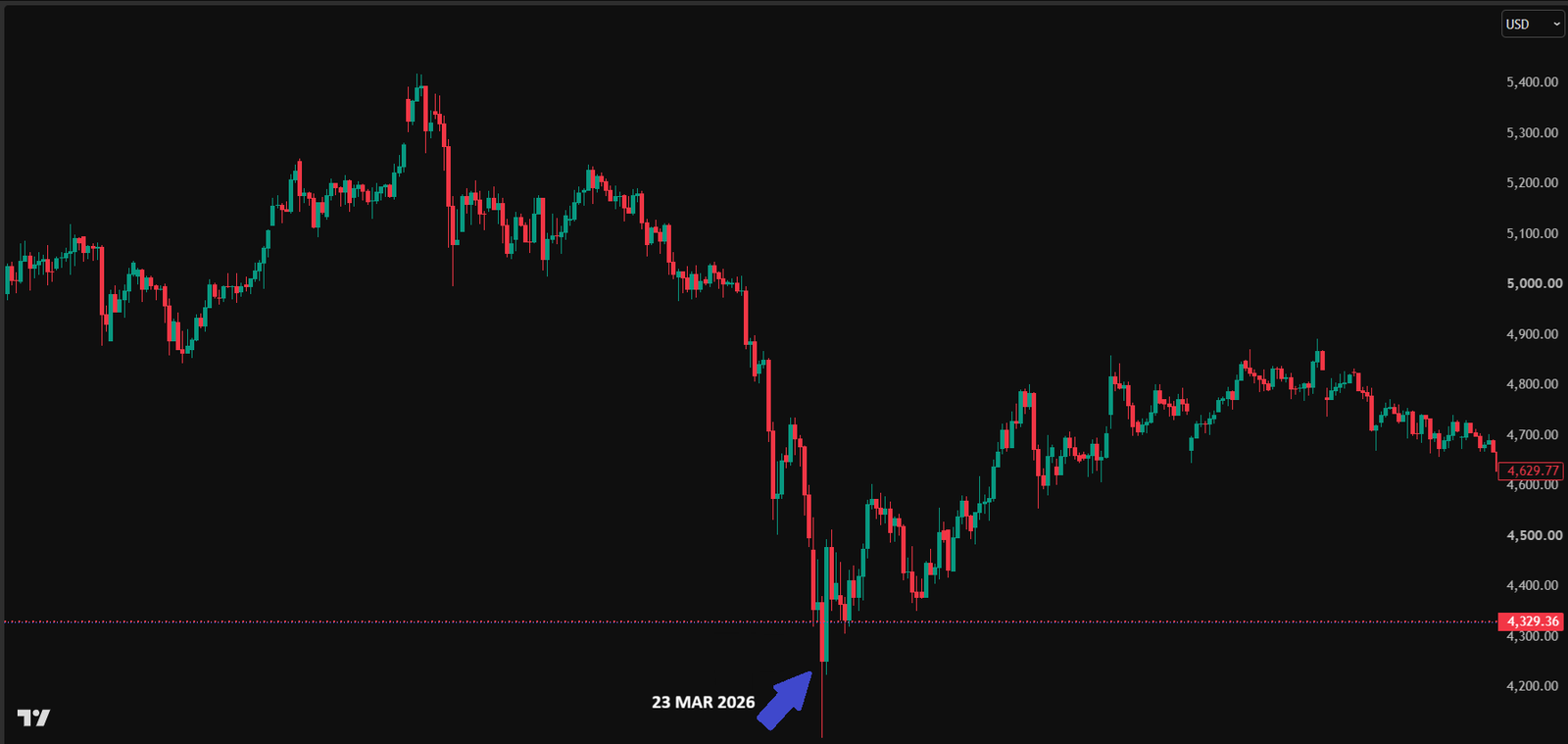
Four-hour gold chart supplied by POLARIS. The arrow marks 23 March 2026, when a sharp intraday sell-off reversed after Trump announced a pause in planned strikes on Iranian energy infrastructure and described talks with Iran.
Open original chartOn a small screen, swipe across the chart. Open the original for full detail.
Original chart pixels preserved. The 23 MAR 2026 label and arrow were supplied by POLARIS; only page framing, caption and accessibility text are added by the theme.
The chart: this was a repricing candle
The H4 chart marks the point where that probability shift became visible in price. Gold was still extending the sell-off into the 23 March low, but the character of the move changed once the political signal hit. Reuters recorded oil plunging and the dollar moving lower after Trump’s comments, while gold recovered from its deepest intraday losses. [3]
The important distinction is between a technical bounce and a narrative reset. Before the headline, the dominant chain was prolonged war → expensive oil → inflation risk → tighter rates → pressure on gold. After the headline, the market had to add a competing chain: possible de-escalation → lower oil → less inflation pressure → less need for higher rates. The candle matters because the second chain suddenly became tradable.
The follow-through confirmed that oil and rates mattered
Two days later, Reuters reported gold up nearly 2% as lower oil eased inflation worries and tempered expectations for rate increases. [5] That follow-through does not prove that one social-media post created a new trend by itself. It does show that the rebound was consistent with the same macro mechanism that had driven the preceding decline, only in reverse.
Uncertainty remained high and the diplomatic claims were disputed. That is why the strongest retrospective conclusion is not ‘peace began here.’ It is that 23 March changed the probabilities the market attached to war duration, oil supply stress and the future rate path.
The lesson behind the candle
Markets do not wait for a political story to become certain. They price distributions of outcomes. A single credible signal can therefore move several markets at once when it changes the probability of the scenario already embedded in prices.
For POLARIS, the 23 March candle is a useful example of why context matters more than the headline alone. The same war that had initially supported safe-haven demand later pressured gold through oil and rate expectations. When the expected path of the war changed, the transmission mechanism changed with it.
Sources & evidence
- World Gold Council — Weekly Markets Monitor: Testing gold’s resolve
- Federal Reserve — FOMC statement
- Reuters — Gold trims losses as Trump postpones strikes on Iran’s energy assets
- ABC News — Trump says US and Iran have major points of agreement
- Reuters — Gold up nearly 2% as uncertainty over Middle East war persists
Educational retrospective analysis. It describes a cross-market repricing around 23 March 2026, not a live trading call and not a claim that one headline explains every subsequent candle.