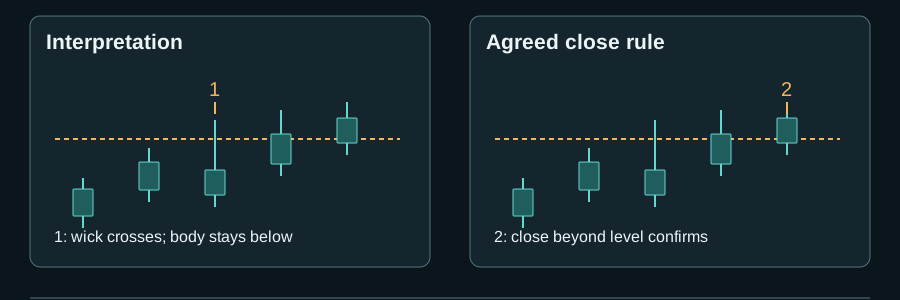
The shared request was to automate a method that was clear to an experienced chart reader but changed subtly between examples. Higher-timeframe structure provided direction, lower-timeframe BOS or CHoCH provided timing, and supply or demand areas helped define location. The challenge was not drawing labels; it was ensuring every label had one stable meaning.
This page combines recurring design and validation lessons without disclosing any client, private rule set, parameter, market, or source implementation.
Composite decision path
Each state is completed before it can influence the next timeframe or action.
- 01ContextRead confirmed higher-timeframe structure from a defined bar and source time.
- 02BreakApply one exact BOS or CHoCH rule to a named structural level.
- 03LocationCreate and invalidate supply or demand areas through deterministic conditions.
- 04TradeApply risk, session, spread, exposure, and expiry rules before any request.
Shared problem
Examples were visually persuasive but not yet consistent enough for code. Similar candles could be labelled as a continuation in one place and a change of character in another. The first phase therefore converted screenshots and explanations into decision questions that could be answered yes or no.
Constraints
The solution had to avoid hindsight, work across several timeframes, preserve the original market idea, and remain fast enough for live operation. It also needed readable logs so a disagreement could be traced to structure, event, zone, risk permission, or execution rather than being called simply a “wrong trade”.
Composite solution
Structure was modelled as a state machine with candidate and confirmed swings. Every break referenced a stored level and source time. Zones had creation, ranking, touch, expiry, and invalidation states. The lower-timeframe engine could request a trade only when its snapshot agreed with valid higher-timeframe context.
Lessons
The strongest validation compared marked charts with event logs on unseen data. Edge cases included equal highs, missing bars, session changes, restarts, rapidly alternating structure, and a higher-timeframe update occurring during a lower-timeframe setup. This protected the interpretation before performance was discussed.
Questions you may have
Does this page reveal a POLARIS entry model?
No. It explains public engineering patterns and deliberately omits reconstructive rules and settings.
Is every SMC concept included?
No. Only the recurring structure, event, zone, timing, and validation problems needed to explain the engineering process are covered.