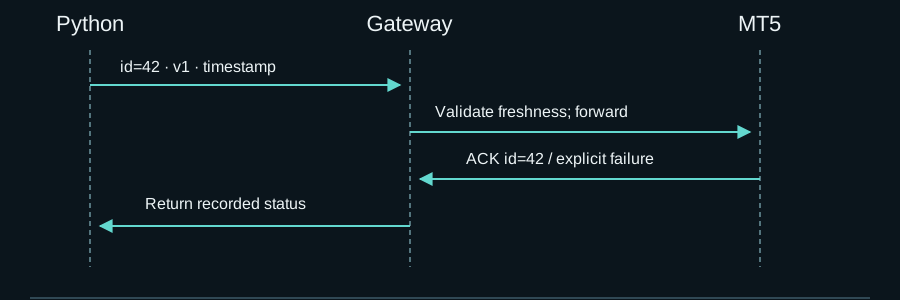
A Python notebook can produce a convincing chart, a stable coefficient, or a ranked list of opportunities. None of those objects is yet an executable trading decision. Live execution needs to know exactly which data existed at the decision time, how the result was transformed, how long it remains valid, and what MT5 should do when any part of the chain fails.
This composite case combines recurring lessons from the anonymized archive. It follows the hand-off from research artifact to confirmed platform action without revealing an original model, instrument, parameter set, client workflow, or proprietary entry rule.
A controlled research-to-execution chain
Each boundary produces a testable artifact and rejects ambiguous state.
- 01FreezeRecord the data cutoff, schema, feature code, model version and approved operating scope.
- 02PublishEmit a small decision object with symbol, direction, source time, expiry and model identity.
- 03QualifyMT5 checks freshness, schema, symbol mapping, account permission, spread and exposure.
- 04ConfirmThe platform verifies the broker result and logs the full decision-to-deal lineage.
The research output was not the trading interface
The first design error was to treat a CSV row or model score as a complete signal. Research code had used cleaned bars, a chosen timezone and a known sample boundary. MT5 saw broker symbols, bid/ask prices, incomplete history and asynchronous ticks. A numerical match was meaningless until both sides shared the same definition of symbol, bar close, price side, missing data, normalization and timestamp.
The hand-off was therefore reduced to a narrow contract. The research layer could remain flexible, but the production output contained only fields the execution layer could validate independently.
Chronology had to survive deployment
Features fitted on the full sample, revised bars, forward-filled values and random train/test splits can introduce information that did not exist when a trade would have been decided. The production pipeline stored a data cutoff and used chronological validation. Every emitted decision carried the source observation time and a separate expiry time.
This made stale information an explicit state. A missing Python process, delayed file, schema mismatch or expired decision could not silently reuse yesterday’s output. The safe result was no new action, while existing positions remained under their documented strategy and risk rules.
Parity was tested before profitability
A small set of frozen observations was calculated independently in Python and through the MT5 adapter. Intermediate feature values, model identity, decision timestamp and final classification were compared before any equity curve was considered. This separated research drift from execution defects.
The test suite also covered symbol suffixes, daylight-saving changes, absent history, duplicate messages, terminal restart, invalid numbers, rejected orders and late broker confirmation. A failure had to be observable and idempotent: retrying the same event could not create a second position.
Execution remained a separate authority
The model proposed a direction; it did not own the account. MT5 retained responsibility for symbol validation, volume rules, portfolio exposure, operating windows and request verification. Model confidence was never allowed to bypass a hard account constraint.
This separation also made rollback possible. A model version could be withdrawn without changing the execution adapter, and an adapter update could be acceptance-tested against a frozen decision set without retraining the model.
Reusable acceptance checklist
A Python-to-MT5 workflow is ready only when an independent reviewer can reconstruct why one decision existed and why the platform accepted, rejected or ignored it.
- Version the dataset, transformations, model and MT5 adapter together.
- Attach source time, creation time, expiry and schema version to every decision.
- Compare intermediate values across Python and MT5 on frozen observations.
- Define safe behaviour for stale, missing, duplicated and malformed input.
- Keep portfolio permission and broker-result verification outside the model.
Questions you may have
Must Python stay open while MT5 trades?
No. The interface may use a service, a scheduled artifact or an exported model. The correct design depends on latency, reliability and maintenance, but freshness and failure behaviour must always be explicit.
Is a matching backtest enough to prove parity?
No. Similar profit can hide different decisions. Compare source data, intermediate features, timestamps, permissions and confirmed trade events.
What should MT5 do with a stale signal?
Reject the new action and log the reason. It should not guess, recreate an old opportunity or silently extend the signal’s lifetime.