From our research notebook

Automating SMC and Price Action

We use a composite case to explain how we worked from annotated charts toward consistent structure, zone and entry decisions.

This example brings together recurring requests from our price-action work. The starting point was a method that made sense to an experienced chart reader: higher-timeframe structure, a lower-timeframe break and a relevant supply or demand area. Our task was to make the interpretation consistent enough to automate.

We turned examples into decision questions

We asked why one swing counted and another did not, what confirmed a break and when a zone stopped being valid. A persuasive screenshot can leave those choices unstated. Answering them gave us a way to compare examples without quietly changing the meaning of the method.

We kept the history of each structure

In the composite design, swings move from candidate to confirmed states. A break refers to a stored level and source time. A zone carries its creation, touch and invalidation history. The lower-timeframe trigger uses valid higher-timeframe context rather than whatever later looks clearest on the chart.

We reviewed the points where interpretations diverge

Equal highs, missing bars, restarts and a higher-timeframe update can all change a decision. We use marked charts and event records to work through those situations. The example illustrates our engineering reasoning; it does not claim a measured outcome for one disclosed strategy.

Explore the technical detailOpen the full method, worked examples and implementation questions. We have kept this material here so you can follow the reasoning as far as you need.

The shared request was to automate a method that was clear to an experienced chart reader but changed subtly between examples. Higher-timeframe structure provided direction, lower-timeframe BOS or CHoCH provided timing, and supply or demand areas helped define location. The challenge was not drawing labels; it was ensuring every label had one stable meaning.

This page combines recurring design and validation lessons without disclosing any client, private rule set, parameter, market, or source implementation.

Composite case · CASE-03

Composite decision path

Each state is completed before it can influence the next timeframe or action.

  1. 01
    ContextRead confirmed higher-timeframe structure from a defined bar and source time.
  2. 02
    BreakApply one exact BOS or CHoCH rule to a named structural level.
  3. 03
    LocationCreate and invalidate supply or demand areas through deterministic conditions.
  4. 04
    TradeApply risk, session, spread, exposure, and expiry rules before any request.

Shared problem

Examples were visually persuasive but not yet consistent enough for code. Similar candles could be labelled as a continuation in one place and a change of character in another. The first phase therefore converted screenshots and explanations into decision questions that could be answered yes or no.

Constraints

The solution had to avoid hindsight, work across several timeframes, preserve the original market idea, and remain fast enough for live operation. It also needed readable logs so a disagreement could be traced to structure, event, zone, risk permission, or execution rather than being called simply a “wrong trade”.

Composite solution

Structure was modelled as a state machine with candidate and confirmed swings. Every break referenced a stored level and source time. Zones had creation, ranking, touch, expiry, and invalidation states. The lower-timeframe engine could request a trade only when its snapshot agreed with valid higher-timeframe context.

Lessons

The strongest validation compared marked charts with event logs on unseen data. Edge cases included equal highs, missing bars, session changes, restarts, rapidly alternating structure, and a higher-timeframe update occurring during a lower-timeframe setup. This protected the interpretation before performance was discussed.

Questions you may have

Does this page reveal a POLARIS entry model?

No. It explains public engineering patterns and deliberately omits reconstructive rules and settings.

Is every SMC concept included?

No. Only the recurring structure, event, zone, timing, and validation problems needed to explain the engineering process are covered.
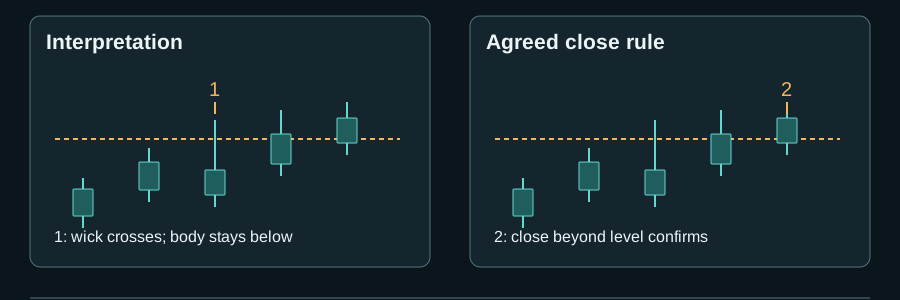
Resolve one interpretation dispute before it becomes code

Scroll the diagram horizontally or open it at full size.

Resolve one interpretation dispute before it becomes code
Educational design example — values and states are not live performance.

Synthetic candles; the same input is shown twice. Level and close rule are explicit.

Open full diagram ↗

Resolve one interpretation dispute before it becomes code

This composite teaching case uses the candle sequence from the deterministic-SMC article. Reviewer A accepts candle 6 as a break because it closes above 102.0. Reviewer B requires a 0.10 tolerance and a strong body, so the break arrives at candle 7. Both readings are plausible until the project chooses one.

Three replay paths after choosing definition B
Path Timestamped states Decision Reason
Entry C7 BOS → zone Z7; C9 first touch; lower trigger C10 Enter after risk permission Context, fresh zone and trigger coexist
Zone invalidation C7 BOS → Z7; C9 closes beyond far edge No entry Zone invalid before trigger
Context change Z7 remains fresh; opposing confirmed break at C9 Cancel setup New context has priority
Failed old test C6 marked BOS under code, B label says no Fail Tolerance/body rule omitted
Corrected test C6 rejected, C7 BOS Pass Code and frozen labels agree

The initial implementation checked close beyond the swing but forgot the agreed body condition. A frozen label test exposed the first disagreement at candle 6. Adding the body and tolerance predicates corrected that defect; it did not prove the resulting strategy profitable.

Every transition stores source candle, confirmation time, prior state and reason. A later neat chart cannot create a state that was unavailable at the original decision time.

What to verify

  • Replay the same candles under both initial interpretations and record the first disagreement.
  • Test entry, zone invalidation and context change with explicit transition order.
  • Keep composite workflow lessons, synthetic prices and any real aggregate archive count clearly separated.

Limits of this example

The case demonstrates how an interpretation is fixed and tested. It does not disclose a client method or report a client result.

Editorial ownership and primary references

Reviewed by POLARIS Research

Evidence scope

This is a composite case drawn from recurring implementation patterns. It is not a description of one identifiable client engagement.

Primary references

These references support platform behaviour or research concepts. They do not validate POLARIS performance and do not guarantee future results.

Explore the next relevant layer

Move between focused research, system engineering and portfolio construction without losing the context of this page.

Contact POLARIS on WhatsApp