From our research notebook

Why Optimization Cannot Rescue a Weak Trading Idea

We explain how we use optimization to examine a defined idea, and why a winning parameter set still needs a credible explanation.

Optimization is useful in our research because it lets us examine how a rule behaves across settings. It also creates a temptation: a search can return an impressive winner even when we have not explained why the idea should work.

We state the idea before expanding the search

We ask what market behaviour the rule is meant to describe and how a simple version behaves after costs. Changing filters, dates and objectives repeatedly also increases the number of choices behind the final report. We keep that selection process in mind when interpreting the winner.

We inspect the neighbourhood

A profitable setting surrounded by poor results raises different questions from a broad area of reasonable behaviour. We examine nearby lookbacks and thresholds, delayed execution and less favourable costs. The purpose is to understand sensitivity, not to declare that a broad plateau guarantees future results.

We decide what would make us stop

We remove components to understand their contribution and challenge the chosen method on data kept out of development. If the basic idea cannot survive realistic costs or small changes reverse its behaviour, another larger search needs a clear justification. Computing more combinations does not answer the original question by itself.

Explore the technical detailOpen the full method, worked examples and implementation questions. We have kept this material here so you can follow the reasoning as far as you need.

Optimization answers a conditional question: which parameter region best expresses a rule on the data and costs supplied? It does not answer the prior question of why that rule should contain repeatable information.

When the underlying idea is weak, a large search can still find an attractive peak. The peak may describe sampling noise, one market regime, an execution assumption or the researcher’s repeated choices rather than a durable mechanism.

Research note · SHORT-08

Idea before parameter search

Every stage can stop the project before the search becomes a story generator.

  1. 01
    MechanismState what market behaviour the rule measures and when it should fail.
  2. 02
    BaselineTest a simple fixed version after realistic costs before widening the search.
  3. 03
    StabilityPrefer broad acceptable regions and consistent neighbouring settings over one peak.
  4. 04
    ChallengeUse untouched periods, ablation, cost stress and forward observation before promotion.

A search algorithm always returns a winner

If hundreds of parameter combinations are compared, one will usually look best even when the rule has little real information. Repeating the search after changing filters, dates or objectives silently increases the number of trials. The reported backtest then includes the researcher’s selection process, not only the strategy.

Robust ideas form regions, not needles

A plausible mechanism should tolerate small changes in lookback, threshold and cost. A lone profitable cell surrounded by failure suggests dependence on exact historical coincidences. A broad plateau is not proof of future profit, but it is more credible than an isolated optimum.

Ablation tests the story

Remove each filter, replace the optimized value with a simple baseline, delay execution and worsen spread or slippage. If the proposed mechanism is real, the direction of the effect should remain intelligible. If every component is necessary only in its exact fitted form, the model is probably explaining the sample rather than the market.

A disciplined stopping rule

Reject the idea when no sensible baseline survives costs, when neighbouring parameters reverse the result, or when untouched data destroys the claimed behaviour. More computing power is not a reason to continue.

  • Write the hypothesis and failure regime before optimization.
  • Limit the search space to economically or mechanically defensible values.
  • Record every material search and comparison, not only the final run.
  • Reserve an untouched final period and keep forward evidence separate.
  • Prefer stable behaviour and explainable degradation over the highest score.

Questions you may have

Is optimization itself bad?

No. It is useful for calibration, sensitivity analysis and operational trade-offs when the hypothesis and validation process are defined first.

Does a flat parameter surface prove an edge?

No. It reduces one fragility concern, but data quality, costs, selection bias, regimes and forward behaviour still require testing.

When should optimization stop?

When a simple baseline fails, neighbouring settings are unstable, or untouched evidence contradicts the proposed mechanism.
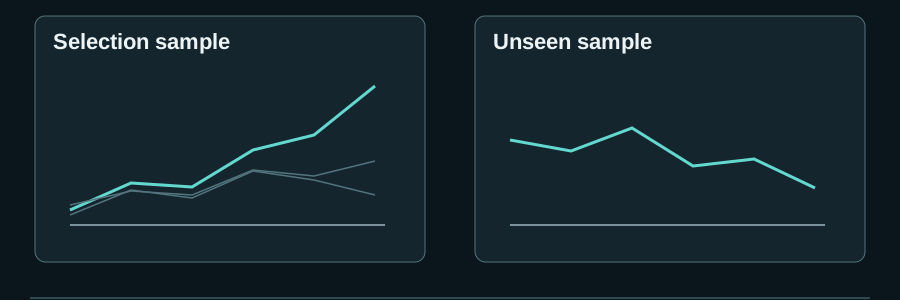
See how searching more can select better-looking noise

Scroll the diagram horizontally or open it at full size.

See how searching more can select better-looking noise
Educational design example — values and states are not live performance.

Same y scale. Highlighted system is frozen before the unseen sample. Synthetic paths.

Open full diagram ↗

See how searching more can select better-looking noise

The following is an illustrative simulation design, not trading data. Each candidate is generated with no true advantage. We select the best development result and then evaluate that frozen candidate on independent data.

Selection from noise — representative simulated outcome
Candidates searched Best development score Independent score Lesson
10 1.1 0.1 Some selection optimism
100 1.9 −0.1 A better-looking winner without a better hypothesis
1,000 2.7 0.0 Extreme development score can still vanish independently

A narrow spike—parameter 17 works while 16 and 18 fail—suggests sensitivity, but a plateau is not automatic proof of an edge. A broad plateau may result from duplicated trades or a slow-changing parameter. Discrete choices such as order type or day of week do not even have a meaningful geometric neighbourhood; compare mechanisms and independent outcomes instead.

Predefine three research outcomes. Reject the hypothesis when the mechanism’s directional prediction fails across adequate independent checks. Mark evidence insufficient when uncertainty is too wide or effective observations are too few. Request an implementation correction when frozen signals, costs or execution do not match the contract; then rerun without calling the defect a market failure. The research log must retain every search, objective, dataset version and selection decision.

What to verify

  • Simulate or resample the full selection process, not only the final parameter set.
  • Keep a truly untouched chronological test and retire it after inspection.
  • Compare spike, plateau and discrete parameters with mechanism-specific stability tests.

Limits of this example

The displayed scores are representative illustrative values. They show the multiple-search mechanism and do not estimate a universal failure probability.

Editorial ownership and primary references

Reviewed by POLARIS Research

Evidence scope

This is an educational design and validation analysis. It explains testable failure modes; it is not evidence that a strategy will be profitable.

Primary references

These references support platform behaviour or research concepts. They do not validate POLARIS performance and do not guarantee future results.

Explore the next relevant layer

Move between focused research, system engineering and portfolio construction without losing the context of this page.

Contact POLARIS on WhatsApp