From our research notebook

Common Problems in Multi-Symbol EAs

We explain why watching several markets required us to manage separate data clocks, symbol properties and decision states inside one EA.

When an EA watches several symbols, the chart it is attached to is only one source of events. Our multi-symbol work made us account for the other markets individually: their prices may arrive at different times and their history may not yet be ready.

We stopped treating one tick as an update everywhere

A loop over symbols does not guarantee fresh data for each one. We track each symbol's latest bar, data readiness and last decision. That helps distinguish a genuinely new event from a repeated check triggered by activity on another market.

We read each market's trading conditions

Point size, tick value, volume step, stop distance, session and filling rules belong to the symbol being traded. We use those properties when forming an order, rather than borrowing them from the chart symbol. The same numerical distance can mean a different financial exposure elsewhere.

We bring the decisions back to one account

Separate symbol states still share account capacity. Before an order proceeds, we consider current and requested exposure together. The technical examples also examine simultaneous candidates, stale prices and restart behaviour, where a simple symbol loop can hide consequential choices.

Explore the technical detailOpen the full method, worked examples and implementation questions. We have kept this material here so you can follow the reasoning as far as you need.

An EA attached to one chart does not automatically receive clean, synchronized events for every symbol it watches. Quotes arrive at different times, histories may load late, trading properties differ, and one account can contain positions from several sources.

A reliable multi-symbol system treats each symbol as its own data and execution state while applying one portfolio-level view of exposure.

Field note · SHORT-06

Before a symbol may trade

Each market passes the same readiness and permission path independently.

  1. 01
    ReadyConfirm current quotes, enough history, synchronized bars, and valid symbol properties.
  2. 02
    TimeDetect the correct bar and session for that symbol rather than the chart symbol.
  3. 03
    RiskNormalize size and combine currency, direction, and account exposure.
  4. 04
    ExecuteUse the symbol’s filling, stop, volume, and market-status rules and verify the result.

Common mistake

The EA loops through symbols on every tick of the chart symbol and assumes that all other markets have updated. This can duplicate decisions, miss bars, use stale prices, or evaluate one market with another market’s timing.

Practical check

Maintain per-symbol state for last bar, data readiness, session, open exposure, and last decision. Read each symbol’s point, digits, tick value, volume step, stops level, and filling rules. Then apply account-wide limits before sending an order.

  • Do not use the chart symbol as the clock for every market.
  • Wait for synchronized history and valid prices.
  • Normalize risk with current symbol properties.
  • Identify positions and pending orders by clear ownership rules.
  • Test simultaneous events, restarts, and partial failures.

Questions you may have

Can one EA trade many symbols from one chart?

Yes, but it must manage data, timing, state, and execution explicitly for every symbol.

Is multi-symbol risk just risk per trade?

No. Correlated markets and simultaneous positions require combined exposure limits.
Make asynchronous symbols share one coherent decision

Scroll the diagram horizontally or open it at full size.

Make asynchronous symbols share one coherent decision
Educational design example — values and states are not live performance.

Illustrative states and times; label the clock and threshold in the real example.

Open full diagram ↗

Make asynchronous symbols share one coherent decision

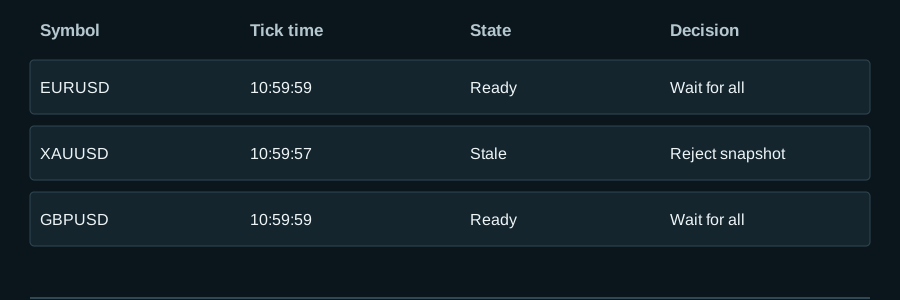
EURUSD and XAUUSD signal at nearly the same moment. The account allows $150 of planned stop loss. Each request needs $90. A timer evaluates readiness because relying only on the chart symbol’s ticks can leave the second symbol stale.

Two-symbol event timeline
Time EURUSD XAUUSD Portfolio state Decision
10:00:00 Fresh signal E1 Last quote is 8s old $150 available Wait; XAU not ready
10:00:03 E1 still valid Fresh signal X1 $150 available Rank by source time then symbol key
10:00:04 Reserve $90 for E1 X1 pending $60 available Send EURUSD; veto XAUUSD
10:00:06 Partial fill confirms $54 risk; $36 request remains reserved Veto persisted $90 committed/reserved No new permission
Restart Rebuild from position and live order Restore X1 veto $90 accounted No duplicate

Changing the arrival order must not change the final account authority. A deterministic tie rule and account reservation achieve that; the winning symbol may differ only when the declared source-time or rank differs. A stale quote is not a low-scoring candidate—it is unavailable.

Committed planned loss is a control estimate, not realized loss. A price gap can make realized loss larger. A partial fill moves only confirmed volume from reserved to position state; the unfilled request remains reserved until cancelled or resolved.

What to verify

  • Replay both event orders, one stale quote and one closed session.
  • Test partial fill, cancellation, missing conversion rate and restart.
  • Assert total confirmed plus reserved risk never exceeds authority.

Limits of this example

A portfolio cap limits modeled decisions; it cannot guarantee the realized loss in gaps or failed exits.

Editorial ownership and primary references

Reviewed by POLARIS Research

Evidence scope

This article combines official platform behaviour with recurring, anonymized implementation patterns. Exact trading rules and client material are excluded.

Primary references

These references support platform behaviour or research concepts. They do not validate POLARIS performance and do not guarantee future results.

Explore the next relevant layer

Move between focused research, system engineering and portfolio construction without losing the context of this page.

Contact POLARIS on WhatsApp