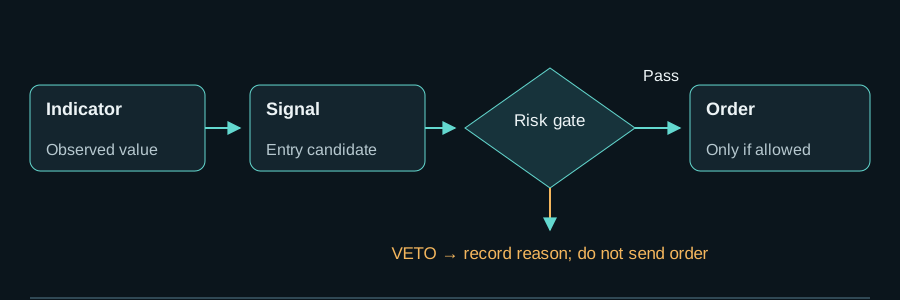
An indicator can make a trading idea easier to see. It does not automatically make the idea ready for automation. A person can look at a colour, arrow, line, or zone and quietly use context that was never written down. An Expert Advisor cannot fill those gaps safely.
Across ten indicator-integration records in our anonymized archive, the recurring difficulty was not simply calling an indicator. The real work was defining what the output means, when it becomes valid, how long it remains active, what cancels it, and which risk and execution rules have authority after the signal appears.
How an indicator becomes a decision
Read from top to bottom: identify the indicator output, define its meaning, fix the decision time, apply trade permission, and record what happened.
- 01SourceName the indicator version, inputs, timeframe, buffer, object, or state being read.
- 02MeaningDefine the previous state, new state, direction, threshold, and tolerance.
- 03TimingChoose current or closed bar, update event, and once-per-bar behaviour.
- 04AuthoritySet what opens, blocks, modifies, or closes a trade—and which rule wins.
- 05EvidenceLog the decision and test restarts, missing data, repainting, and duplicate events.
Start with the output
Before discussing entries, the developer needs to know what the indicator actually exposes. A visible arrow may come from a numeric buffer, a chart object, a colour index, or a calculation that changes while the candle is open. Two indicators that look similar can require completely different integration methods.
The specification should record the indicator version and inputs, the exact value to read, the valid empty state, and the bar index. If only a compiled indicator is available, the integration also needs a short feasibility check. The EA should never assume that a visual element is stable or accessible simply because it appears on the chart.
Turn appearance into states
“The line turns blue” is useful human language. Code still needs a state transition. Was the previous value red? Did the blue state appear for the first time? Is a missing value different from neutral? Can the signal remain blue for twenty candles, and if so should the EA act once or once per candle?
A simple state model usually includes inactive, armed, triggered, blocked, and reset. The names can change, but the separation matters. It prevents a persistent indicator condition from opening repeated positions by accident and makes the behaviour easier to test against screenshots and logs.
Choose the decision moment
An indicator value on the current candle may change several times before close. Acting intrabar can be correct for a fast strategy, but that choice must be deliberate. Waiting for a closed candle is slower and often easier to reproduce. Neither policy is universally better; mixing them without saying so is the real problem.
The same decision applies to exits. A signal can disappear intrabar and return before close. The system must state whether disappearance is enough, whether a confirmed opposite state is required, and whether an emergency risk rule may close the trade earlier.
Separate signal from trade permission
A valid signal does not always mean a valid order. Existing exposure, spread, session limits, maximum trades, symbol settings, data readiness, or a portfolio-level stop may block the action. Keeping the signal state separate from trade permission makes the reason visible: the setup existed, but execution was not allowed.
This separation is especially important when several indicators confirm one another. The logic should define whether all conditions must be true at the same snapshot, whether one signal may remain armed while another arrives later, and how old a confirmation may become before it expires.
Test the awkward cases
Normal entries are only the first test. A dependable implementation also needs checks for terminal restart, timeframe change, missing history, a late-loading custom indicator, an empty buffer, duplicate ticks, broker suffixes, and an order that is requested but not filled.
Logs should show the indicator state, bar time, confirmation state, risk permission, and order result. That evidence does not make a strategy profitable. It does make disagreement diagnosable and protects the original idea from silent technical drift.
- Identify the exact indicator version, inputs, buffer or object, and timeframe.
- Define current-bar or closed-bar behaviour and the precise update event.
- State whether a persistent condition triggers once, once per bar, or repeatedly.
- Define confirmation age, reset conditions, conflict handling, and trade permission.
- Record enough decision data to reproduce a missed, blocked, or duplicated trade.
Questions you may have
Can every custom indicator be used by an EA?
Not automatically. The output must be accessible and stable enough for the intended decision rule. A compiled-only or object-based indicator may need a feasibility check.
Should an EA always wait for a closed candle?
No. Intrabar logic can be valid, but it must be specified and tested as intrabar logic rather than judged later from a closed chart.
Does adding more confirmation indicators improve reliability?
Only when each condition has a clear role and timing policy. More filters can also reduce opportunity, create contradictions, or hide ambiguity.