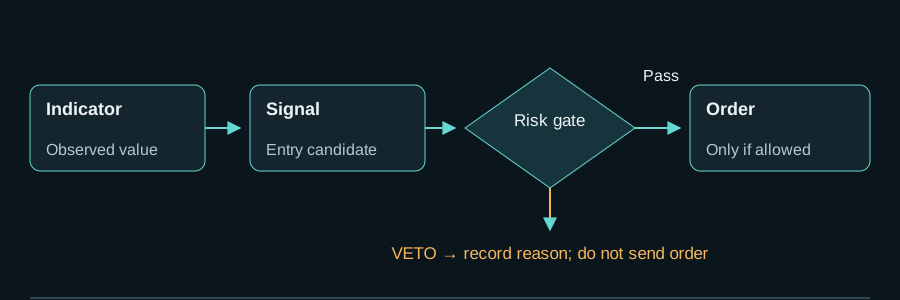
The two tools can live inside one program, but they answer different questions. A signal engine describes market opportunity. A risk manager describes permission, size, supervision, and stop authority.
The risk-focused archive cluster included both full Expert Advisors and separate trade-management tools. That split is useful because a good signal can still arrive when the account should not add exposure.
Who makes which decision
The signal module finds the opportunity. The risk module decides permission and size. The order and monitoring layers carry out and supervise the approved action.
- 01Signal EADetects context, setup, direction, trigger, and strategy invalidation.
- 02Risk managerCalculates size, checks exposure, session, equity, margin, and emergency state.
- 03Order layerActs only after permission, then verifies the broker response and protection.
- 04SupervisorMonitors open exposure and can reduce, block, or close according to mandate.
Signal responsibility
The signal EA owns the market logic: filters, setup, direction, entry timing, and strategy-specific exit conditions. It should be able to report that a setup existed even when no order was allowed.
That distinction makes evaluation honest. A blocked signal is not the same as a missing signal, and an execution failure is not the same as a strategy decision.
Risk responsibility
The risk manager owns exposure: intended loss, allowed volume, existing positions, daily or weekly state, equity, margin, and emergency conditions. Depending on its mandate, it may supervise one EA, a symbol group, or the entire account.
Its decision should be simple and auditable: allowed, reduced, blocked, or emergency action—with a recorded reason and reset policy.
Why separation helps
Separate responsibilities make testing and portfolio control easier. The signal module can be tested for behavioural accuracy, while the risk module can be stress-tested with artificial exposure and failure states.
They may still be delivered in one EA. The architectural boundary matters more than the number of files: opportunity proposes; risk disposes.
Questions you may have
Do I need a separate risk-manager EA?
Not always. The functions can be inside the signal EA, provided responsibilities and authority remain clearly separated.
Can one risk manager supervise several EAs?
Yes, if position ownership, account scope, priority, and emergency behaviour are defined carefully.