From our research notebook

MT4 to MT5 Migration

In this composite migration case, we explain how we separated platform adaptation from deliberate changes to the original strategy.

We bring recurring migration requirements together in this case. Some source systems were compact EAs; others depended on indicators, panels or management tools. The common request was to move the work to MT5 while preserving the intended trading behaviour.

We asked what had to stay equivalent

Old code can mix intended rules, platform workarounds and defects. We separate those before rebuilding. A deliberate correction needs to be recorded as a change, so it does not disappear inside a claim that the two versions are identical.

We rebuilt one responsibility at a time

The composite approach pairs a fixed MT4 reference with MT5 modules for indicators, risk and order handling. Account mode, symbol properties and fill policies are mapped explicitly. We compare decisions at matched events, not just the ending balances of two reports.

We made later maintenance part of the hand-off

The useful output includes a record of explained differences and assumptions, alongside the new implementation. Restart and execution scenarios help us inspect the parts a successful compilation cannot establish. This is a process example drawn from recurring work, not a performance report for one client system.

Explore the technical detailOpen the full method, worked examples and implementation questions. We have kept this material here so you can follow the reasoning as far as you need.

The shared request was to move a working or partly working MT4 system into MT5 without changing what the strategy meant. The source ranged from compact EAs to projects dependent on custom indicators, dashboards, or trade-management utilities. Compilation was only the first checkpoint.

This composite case focuses on the migration process. It does not reproduce one client, one codebase, or one trading method.

Composite case · CASE-04

Composite migration path

Reference behaviour remains visible through every implementation change.

  1. 01
    BaselineCapture inputs, signals, trade events, logs, account mode, and representative tests in MT4.
  2. 02
    TranslateMap orders, positions, indicators, events, prices, symbol properties, and persistence.
  3. 03
    CompareMatch decisions on controlled periods before comparing aggregate performance.
  4. 04
    ReleaseTest broker constraints, restarts, failure paths, and document every accepted difference.

Shared problem

The old source mixed strategy decisions with platform mechanics. Some behaviours were intended, some were historical workarounds, and some looked like defects. Rewriting everything at once would make it impossible to tell whether a changed trade came from MT5 or from a hidden strategy correction.

Constraints

The migration had to support the selected MT5 account mode, symbol properties, indicator handles, event timing, and broker filling rules. Where an MT4 behaviour was ambiguous, the accepted interpretation had to be documented before it entered the new implementation.

Composite solution

The work was split into a compatibility map and a behavioural comparison. Signals and risk values were logged from a fixed MT4 reference. MT5 modules then reproduced one responsibility at a time. Matched periods were compared at the event level, and deliberate corrections were tracked separately from parity work.

Practical outcome

The result was not “the same file on a newer platform.” It was a maintainable MT5 system with an explained relationship to the old behaviour, documented account assumptions, and tests that could catch future drift.

Questions you may have

Was this one migration project?

No. It combines recurring patterns from multiple completed conversion and integration assignments.

Why not improve the strategy during migration?

Improvements can be valid, but they should be isolated from parity work. Otherwise a platform difference and a strategy change become impossible to distinguish.
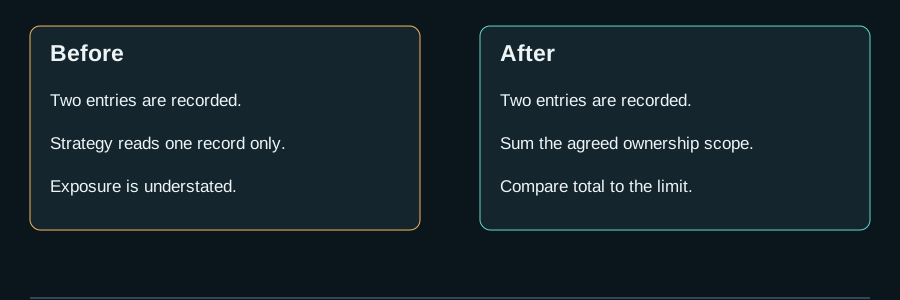
Trace one semantic difference from discovery to acceptance

Scroll the diagram horizontally or open it at full size.

Trace one semantic difference from discovery to acceptance
Educational design example — values and states are not live performance.

Synthetic test: 0.2 + 0.3 units → expected owned exposure = 0.5 units.

Open full diagram ↗

Trace one semantic difference from discovery to acceptance

The archive’s 12 conversion-and-integration records form one combined scope. They are not automatically twelve MT4-to-MT5 migrations; the public rows do not separate conversion direction, integration-only work or behavioural acceptance. The case below is a constructed migration example.

One MT4 event trace mapped to MT5
Stage MT4 reference MT5 candidate Acceptance
Signal M15 bar 10:15, event S17 Same source time and inputs Exact
Size 0.30 lots after rounding 0.30 lots from active symbol properties Exact or justified currency tolerance
Request BUY market ticket BUY request ID R17 Semantically mapped
Execution Ticket records fill Deal D17 creates/changes position P4 Volume and price within stated tick/slippage tolerance
Exit Close 0.10 by ticket Opposite deal reduces net position Remaining exposure 0.20

The first port treated an MT5 order ticket as if it were the lasting position identity. After a partial fill and restart, it searched the wrong object and sent the exit again. The reproducible failure trace showed the duplicate. The correction persists the strategy event and request IDs, then rebuilds state from deals and the current position. A regression test repeats partial fill, restart and delayed confirmation.

If the target account is hedging, separate position tickets can preserve a closer MT4 mapping. In netting, the agreed reference is net exposure plus an external ownership ledger. That is an approved semantic adaptation, not an invisible code detail.

What to verify

  • State which of the 12 public records actually supports the claim; otherwise keep it aggregate and limited.
  • Freeze signal, size, request, deal, position and exit traces before changing code.
  • Classify mismatches as defect, approved platform adaptation or non-comparable input data.

Limits of this example

The scenario is reconstructed for education and is not represented as a published client incident or measured project outcome.

Editorial ownership and primary references

Reviewed by POLARIS Research

Evidence scope

This is a composite case drawn from recurring implementation patterns. It is not a description of one identifiable client engagement.

Primary references

These references support platform behaviour or research concepts. They do not validate POLARIS performance and do not guarantee future results.

Explore the next relevant layer

Move between focused research, system engineering and portfolio construction without losing the context of this page.

Contact POLARIS on WhatsApp