A good backtest is not useless. It is one of the most important tools in systematic trading. The problem begins when we ask it to prove more than it can prove.
A historical test can show how a precise rule set behaved inside a particular data and execution model. It cannot, by itself, show that the same behaviour will survive unseen data, different spreads, delayed fills, platform details, or a market regime that was under-represented in development.
How validation moves forward
Each step answers a separate question, from whether the idea makes sense to whether its real behaviour remains within the expected limits.
- 01Market logicIs there a reason for the rule to exist?
- 02Historical modelHow did the exact rules behave under stated assumptions?
- 03Stress checksDo nearby settings, costs, and feeds change the conclusion?
- 04Unseen dataDoes the result survive data that did not shape development?
- 05Forward observationDoes timing and execution remain credible as data arrives?
- 06Live monitoringDoes real behaviour remain inside the defined risk and operating limits?
Data can flatter the result
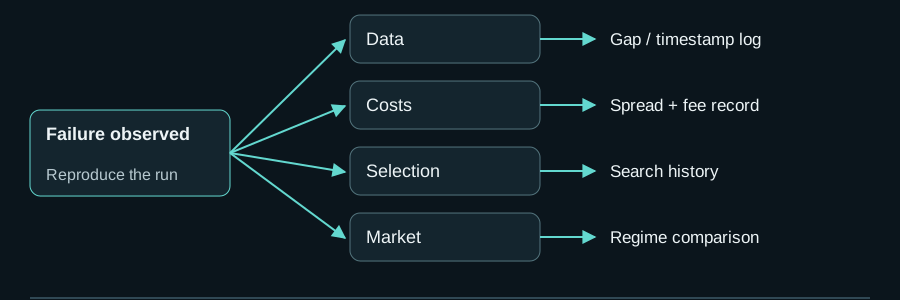
Missing ticks, synthetic history, incorrect symbol settings, convenient spread assumptions, or accidental look-ahead can all improve a report without improving the strategy. Even clean data can become contaminated when parameter choices are repeatedly adjusted after seeing the same period.
The response is not to avoid optimization. It is to define a sensible parameter area, calibrate with a clear purpose, and reserve untouched data for a decision the development sample cannot influence.
Execution changes the trade
In live trading, the requested price is not always the filled price. Spread expands, liquidity changes, orders can be delayed or rejected, and brokers may differ in contract settings or price feeds. A strategy that depends on very small edges is especially sensitive to these details.
A realistic test therefore needs defensible costs and a clear view of how the platform handles orders, stops, sessions, and missing data.
Parameters can be fragile
One profitable parameter set is less convincing than a stable area where nearby settings behave reasonably. If a small change turns a good curve into a collapse, the test may have found a historical accident rather than a durable relationship.
Sensitivity checks, shifted data, alternative feeds, and stress assumptions help reveal whether the idea has room to breathe.
Markets change
A strategy may be valid and still enter a weak season. Trend, volatility, liquidity, correlation, and participant behaviour change over time. No historical window contains every future combination.
This is why portfolio role and ongoing monitoring matter. A system should be judged against the behaviour it was built to express, not against the expectation that it must profit in every month.
A stronger validation chain
Our preferred sequence is: logical market idea, long historical test, careful calibration, sensitivity and stress checks, untouched out-of-sample data, forward observation, and then live monitoring under defined risk.
Passing every stage still does not guarantee profit. It does make the evidence more honest and exposes weaknesses earlier, when they are cheaper and safer to address.
- Separate development data from final validation data.
- Use realistic spread, commissions, slippage, and order constraints.
- Check nearby parameters and alternative data feeds.
- Compare historical expectations with forward and live behaviour.
- Define risk and stop conditions before deployment.
Questions you may have
Does this mean backtests are unreliable?
No. A well-designed backtest is essential evidence. It becomes unreliable when data, assumptions, or interpretation do not match the question being asked.
Is out-of-sample testing enough on its own?
No single stage is enough. Out-of-sample, forward, and live observation test different weaknesses.