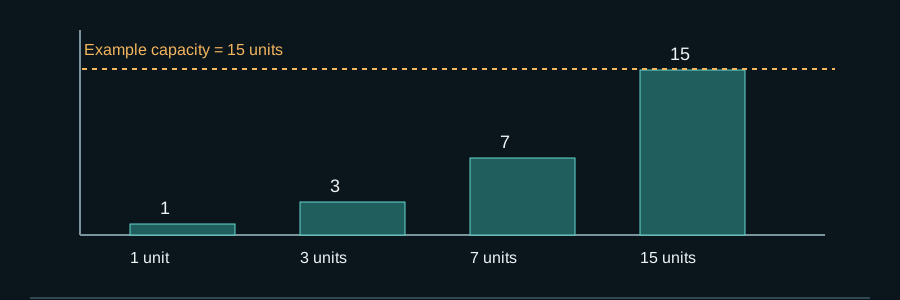
Grid, martingale and hedging requests appear often in automated-trading development. Our anonymized archive contains 33 projects in this broad family. The names can describe very different systems, but they share one engineering question: what happens when exposure grows while the market keeps moving against the original assumption?
The useful discussion is not whether a label is good or bad. It is whether the system makes exposure visible, defines an end to the sequence, and remains controllable when spread, margin, execution, or market behaviour becomes uncomfortable.
A safer order of design
The sequence begins with a fixed account boundary, not with the spacing between orders.
- 01LimitDefine the maximum permitted exposure, loss, margin use, and sequence length.
- 02MeasureRecalculate basket risk from current positions, costs, and actual broker conditions.
- 03ExitSpecify normal, time-based, risk-based, and emergency exits before entry.
- 04StopBlock new orders when data, liquidity, execution, or account conditions are unsafe.
Exposure first
A sequence can look calm while its open risk is accelerating. Lot progression, order distance, correlated symbols, swap, commission, and floating loss all affect the real burden. The EA should therefore calculate total basket exposure and remaining capacity before every new order, rather than relying on the number of open tickets alone.
Exit authority
A basket needs more than a profit target. It needs a maximum loss, a time boundary, a rule for abnormal spread or missing prices, and a clear answer when an order or close request fails. A hedge may change directional exposure, but it does not erase costs, margin use, execution risk, or the need for an exit.
Test the sequence
Normal backtests often understate the situations that matter most. Stress work should include wider costs, fewer fills, gaps, delayed execution, terminal restarts, and long one-sided moves. Nearby parameter sets should also be checked; a design that depends on one exact spacing or multiplier is difficult to trust.
Portfolio use
If a high-exposure method is used at all, its allocation should be judged by its worst credible basket behaviour, not by its normal month. It also needs portfolio-level limits so several systems cannot unknowingly build the same market exposure at once.
- Cap money risk and margin use independently.
- Define the final allowed order before the sequence starts.
- Verify broker results; a requested close is not a completed close.
- Pause on abnormal data, spread, liquidity, or execution.
- Review combined account exposure, not only one EA.
Questions you may have
Does hedging remove risk?
No. It can alter directional exposure, but costs, margin, execution, correlation, and exit risk remain.
Can a grid be made safe?
No trading structure is risk-free. Clear caps and controlled exits can limit known exposure, but gaps, slippage, and abnormal conditions can still exceed intentions.