A low win rate does not prevent a trading system from being profitable. It only says that winning trades occur less often. Profitability depends on what those wins are worth relative to the losses.
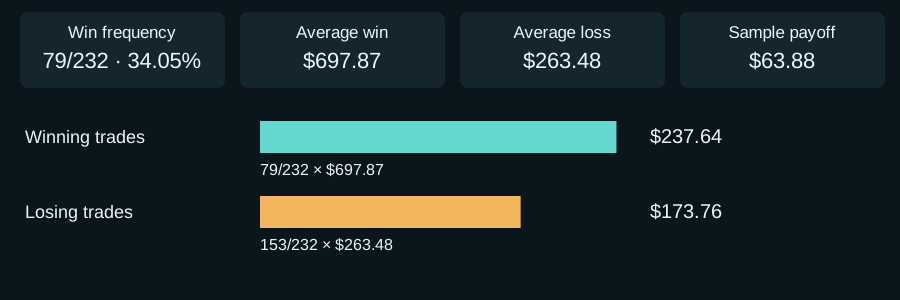
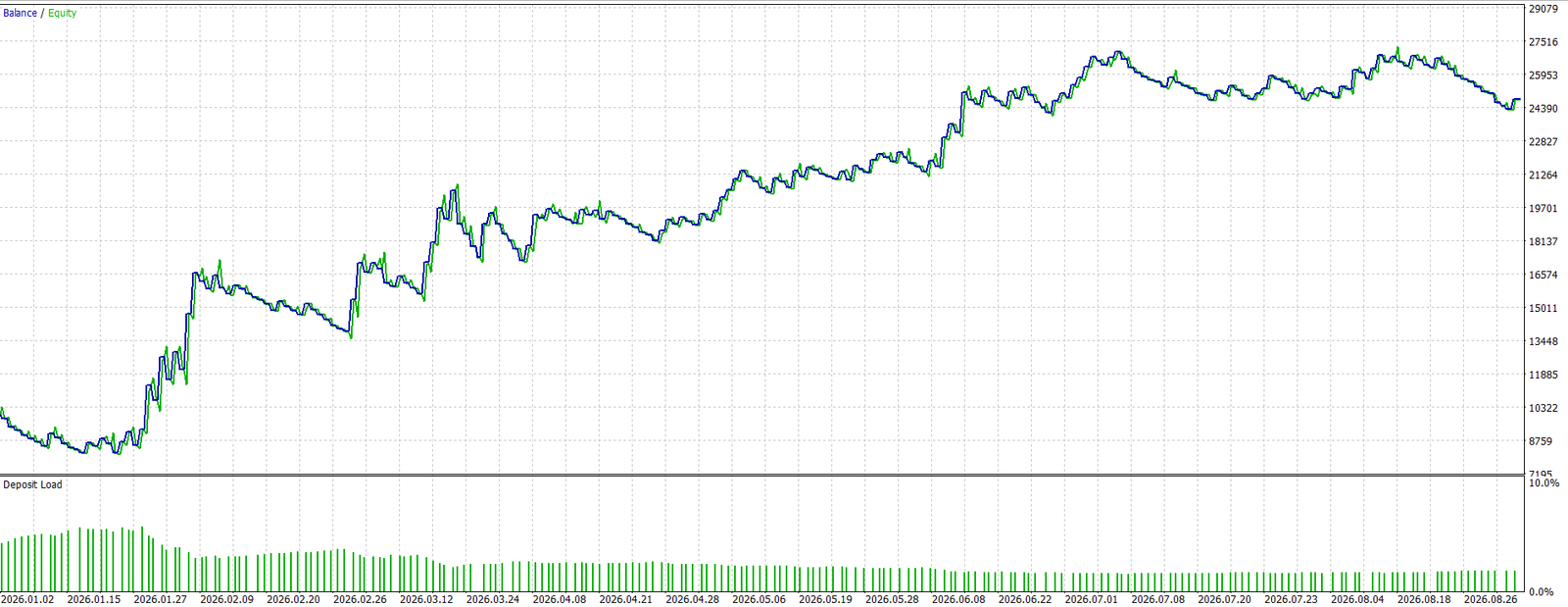
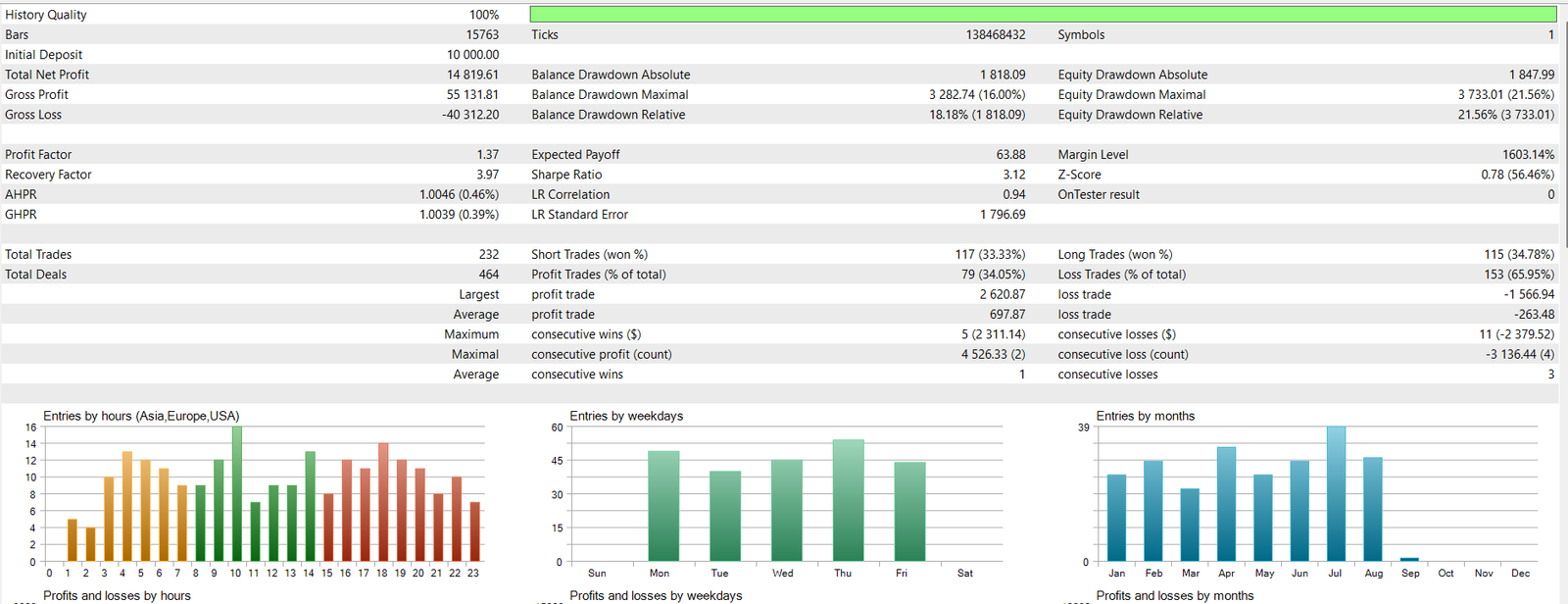
This documented MetaTrader 5 backtest makes that distinction visible. From January to August 2026, the example robot closed 232 trades. Only 79 were profitable: a win rate of 34.05%. Yet a USD 10,000 initial deposit finished with USD 14,819.61 in net profit, or +148.20%.
This result is not evidence that the robot is robust, safe or likely to repeat the same return. It demonstrates one narrower mathematical point: a system can lose more often than it wins and still have positive expectancy.
Win rate measures frequency, not profitability
Win rate answers one question: how often did a trade finish in profit? It does not say how large the average winner was, how expensive the average loser was, or how severe the path between the two became.
A more useful first calculation is expectancy per trade:
E = (p × W) − ((1 − p) × L)
p = win rate · W = average winning trade · L = absolute average losing trade
For this report:
- p = 0.3405
- W = USD 697.87
- L = USD 263.48
E = (0.3405 × 697.87) − (0.6595 × 263.48) = 237.62 − 173.77 ≈ USD 63.86 per trade.
The report shows an expected payoff of USD 63.88; the small difference comes from using rounded values displayed in the screenshot. The same idea can be written as a profitability condition:
p × W > (1 − p) × L
(p × W) ÷ ((1 − p) × L) = 1.37
Here, the average winner was about 2.65 times the average loser. The break-even win rate implied by those average trade sizes was only about 27.41%:
Break-even win rate = L ÷ (W + L) = 263.48 ÷ (697.87 + 263.48) ≈ 27.41%
The observed 34.05% win rate was above that threshold. That—not the win rate in isolation—is why the sample could finish profitable.
Profitable does not mean comfortable—or safe
The same report records a maximum equity drawdown of 21.56% and a run of 11 consecutive losses. A low-win-rate system can therefore be mathematically profitable while still being psychologically difficult and exposed to meaningful sequence risk.
Expectancy is a better starting point than win rate, but it is not a complete validation. Costs, slippage, sample size, parameter stability, out-of-sample tests, forward performance and drawdown must still be examined. MetaQuotes defines expected payoff as the statistically calculated average return of one trade and separately reports profit factor, drawdown, winning trades and losing trades in the Strategy Tester report.
Conclusion: You do not need to win most trades to grow an account. You need the probability-weighted value of the average winner to exceed the probability-weighted cost of the average loser—and you need a risk structure capable of surviving the losing sequences.
Primary platform reference: MetaTrader 5 Help — Testing Report.